- Drawings by Brooks Kim
- Posts
- Are You 'Stitching' Your Drawings Instead of Drawing Them? 🪡
Are You 'Stitching' Your Drawings Instead of Drawing Them? 🪡
Why your hand draws something different from what your eyes see.

brooks kim
February 03, 2026
Hello, Artists!
I hope you had a creative week.
Today, I want to talk about a mystery that every artist faces at least once: "I copied the reference exactly as I saw it, so why does it look distorted when I’m done?"
Have you been blaming your "clumsy hands"? Stop right there. It’s not your hands. The culprit is actually your eyes—specifically, because they are working too hard.
1. It’s Not Handwork, It’s Brainwork
Drawing happens in a 3-step process: [ Input → Interpretation → Output ]
Most distortions don't happen during the Output (hand) phase. They happen during Interpretation.
Our brains have limited RAM. We cannot "Copy & Paste" the entire world at once. Therefore, the order in which you input visual information determines the fate of your drawing.
2. The Beginner’s Eye: Missing the Forest for the Trees
Let me show you the most common pattern that ruins a drawing. Take a look at the process below.
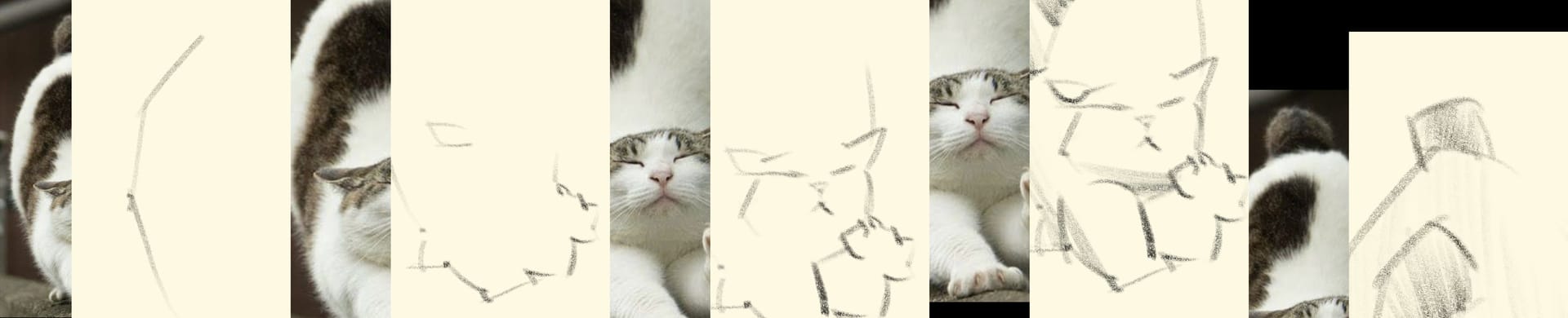
A fragmented, zoomed-in approach
Does this process look familiar?
Zoom in on the back line → Draw it.
Zoom in on the ear → Draw it.
Zoom in on the paw → Draw it.
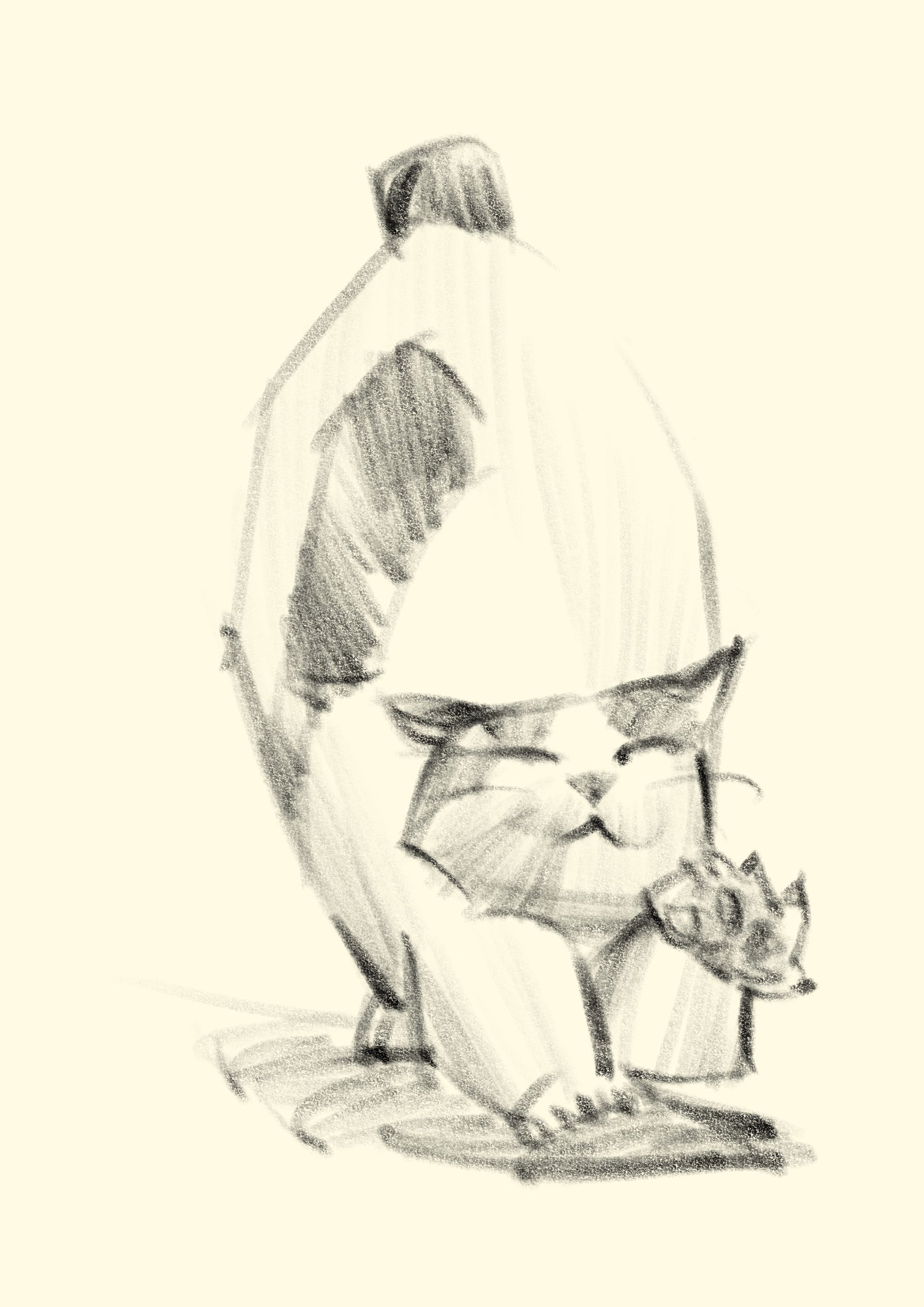
The result of chasing lines: A collapsed form.
This is like sewing with a needle. Your eyes dart back and forth between the reference and the canvas every single second.
❌ Why this causes distortion: When you focus only on the parts, you lose your "Reference Points." You are stitching together high-quality parts, but without a map. The result? A "Frankenstein" cat where the parts don't fit together.
3. The Pro’s Eye: Catching the Flow First
Now, let’s look at how an artist with strong form sensitivity approaches the same subject.
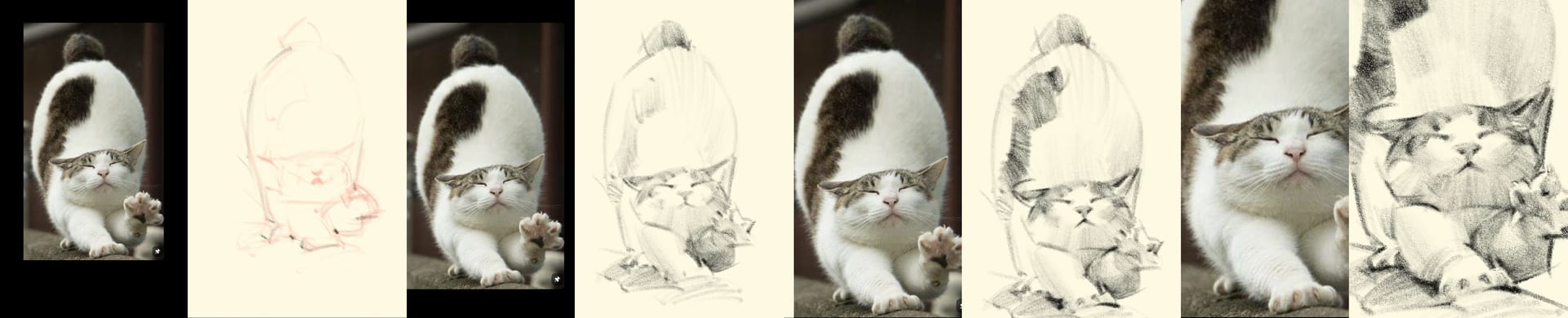
Capturing the flow and big shapes first
Can you feel the difference? They never start with fur or pupils.
Step 1. Gesture & Flow Look at the first drawing on the left. There are no eyes or paws. There is only the 'Flow of the Spine' and the 'Big Mass.'
"Ah, this cat is stretching like a taut bow."
Step 2. Structure They add volume to that flow. They use simple shapes like cylinders and spheres, not complex muscles yet.
Step 3. Details (Finally!) Only after the structure is solid do they zoom in to draw the eyes, nose, and fur.
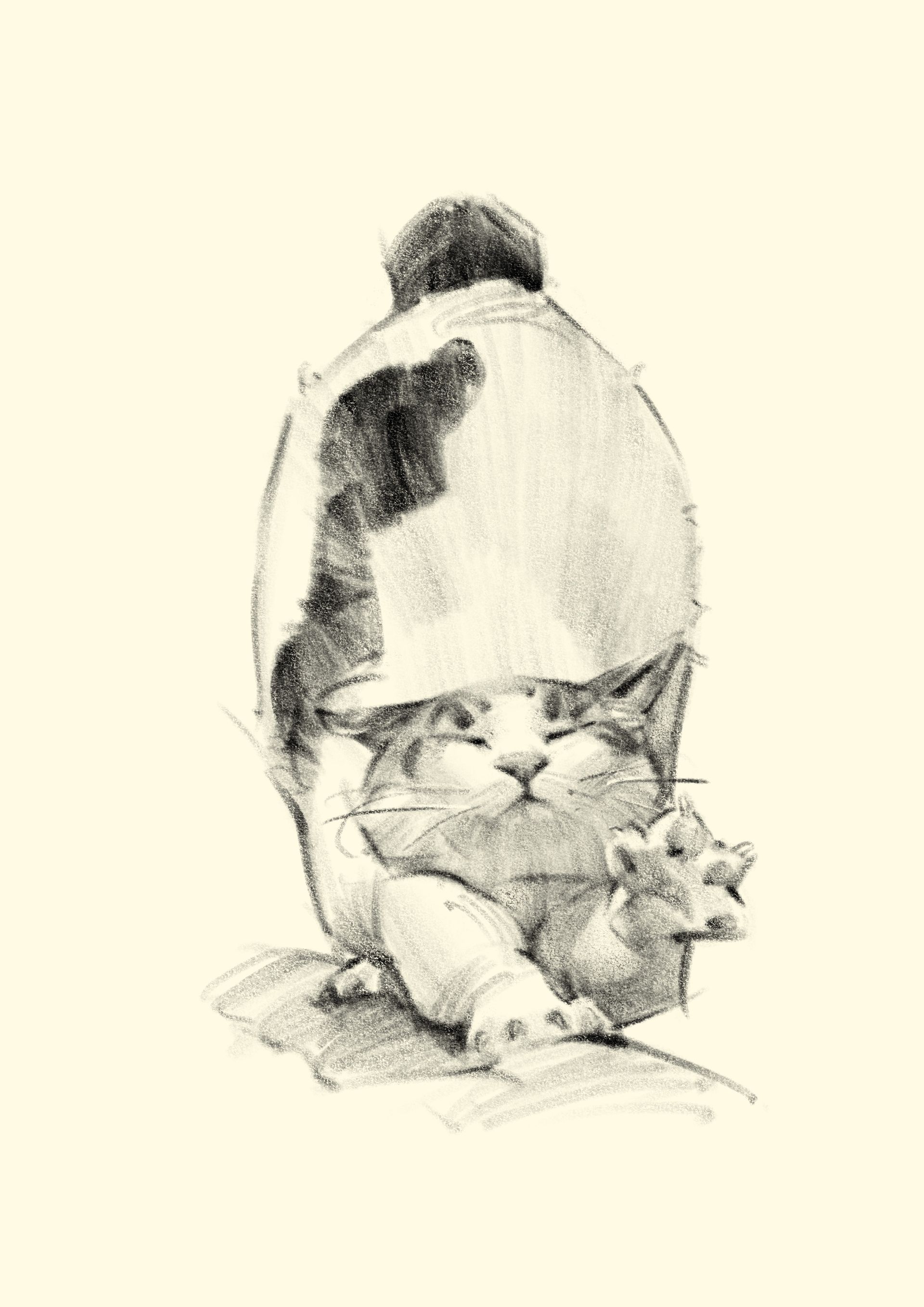
Starting from the big picture, then gradually zooming in to build details.
4. The "Right Eye" Trap (Understanding Context)
Here is the most critical shift in mindset.
❌ Beginner's Mind: "Now I need to draw the Right Eye!" (See it as an independent object)
⭕ Pro's Mind: "I need to draw the eye located on the right side of this face's flow." (See it as a part of the whole)
It sounds like a word game, but the result is drastically different.
If you just try to draw "a right eye," your brain will paste the "symbol of a pretty eye" it has memorized. You ignore the angle and perspective.
But if you see it as "a part of the whole," you understand the Context:
"Since the cat is twisting its head, the right eye should look squashed and hidden by the nose."
🧠 This Week’s Takeaway: Be "Lazy" with Your Eyes
Remember, Artists. There are no independent parts on your canvas. Everything is a word within the sentence of "Context."
Don't check your reference every second. Frequent checking means you don't have a "Map of the Whole" in your head.
Ditch the Microscope View (The first example).
Adopt the Telescope View (The second example).
[Coming Up Next Week] "Okay, I get the theory. But how do I actually train my eyes to see the big picture?"
In the next issue, I will bring you 3 Brain Training Methods to forcibly expand your vision and stop the distortion.
See you in the next newsletter!
📬 Got Questions? If you have any questions about today's topic or feel stuck with your drawing, just hit reply to this email. Or, you can write to me directly at: [[email protected]] I read every message from my fellow artists and would love to help.
👀 Want to See More Sketches? I post my daily sketches, raw studies, and quick tips much more frequently on Threads. If you want to see how I apply these theories in real-time, come say hi!