- Drawings by Brooks Kim
- Posts
- Don’t Just Draw Lines. Draw the Form.
Don’t Just Draw Lines. Draw the Form.
Every line builds shape — or breaks it.

brooks kim
June 21, 2025
When we draw, it’s easy to focus on the line itself — how fluid it feels, how continuous, how expressive.
But a line isn’t just a trail — it’s a container.
It describes the volume, direction, and logic of a form.
A common mistake is to get lost in the motion and rhythm of linework, while forgetting what the line is supposed to shape.
Let’s take a look at the image below, which compares two cups.
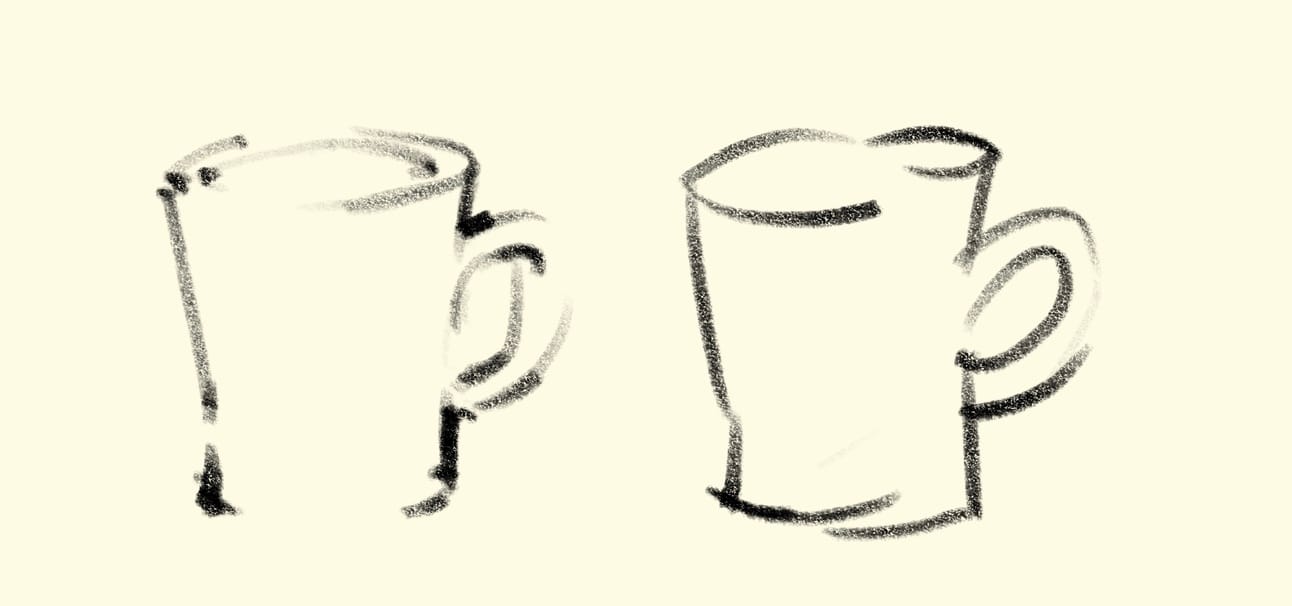
One is drawn with light, broken lines; the other with bold, clean ones. Only one of them holds the form.

Left: broken line, clear shape. Right: clean line, broken form.
A line’s strength means nothing if it doesn’t respect the form.
A line can be soft, strong, thick, or sketchy — but it must always serve the shape.
The same applies when drawing something more complex, like a cat.
The line may change in weight, pressure, or speed, but it must continue to describe volume.
If you zoom out, you’ll notice: every stroke is part of a larger wrapping motion around form.
Let’s look at the example below — a sketch where lines shift in weight and tone as they follow the cat’s form.

Lines change—but always follow the form.
To make this even clearer, the next image shows simplified silhouettes.
These diagrams show how line placement reflects structure — even without detail.

The best lines hold structure, not just style.
So when you draw — even loosely — ask yourself:
Does this line describe surface?
Or is it just floating in space?