- Drawings by Brooks Kim
- Posts
- Style or Habit?
Style or Habit?
How Confirmation Bias Shapes the Way We Draw

brooks kim
October 14, 2025
🧠 Confirmation Bias — and How It Shows Up in Drawing
There’s a term in psychology called confirmation bias.
It describes how our brain tends to trust what’s familiar —
and quietly ignore anything that challenges it.
In drawing, it often looks like this:
You draw the eyes higher than they really are — because that’s how you always do it.
You flatten the jawline — because that’s what your hand remembers.
You draw what you expect, not what you actually see.
And from that moment, your drawing starts to drift — gently, almost invisibly.
🎨 Style vs Habit
These small distortions can feel natural.
Sometimes they even look like style.
But here’s the difference:
Habit (Bias) | Style (Choice) | |
|---|---|---|
Source | Repetition | Intention |
Based on | Familiarity | Observation |
Result | Unconscious distortion | Designed expression |
✅ Style is a decision.
❌ Habit is a reflex.
✏️ Six Ways to Break Habitual Seeing
Look at the spaces between forms.
Focus on the “in-between” areas — not just the subject itself.
Often, that’s where distortions become most visible.Flip your canvas horizontally.
Your eyes get comfortable quickly.
Flipping the image makes it unfamiliar again,
helping you see what’s actually off.Step back from your canvas.
Zoom out, or literally stand back.
The overall balance of light, shape, and proportion becomes clearer.Convert your image to grayscale.
Removing color reveals the true structure of values and edges.Rotate it upside down.
Seeing your work inverted helps you read it as pure design —
shapes, rhythms, and patterns — not a face or figure you “know.”Cover part of the image.
Block one half with your hand or a piece of paper.
It forces you to see the flow of each part,
instead of being trapped by the whole.
🧩 My Own Habits
In my case, I’ve noticed I tend to draw heads slightly larger than they should be.
It’s not something I consciously plan —
I think it comes from my background in character and animation design,
where that proportion feels natural.
But when it comes to perspective and space,
I sometimes distort things intentionally.
I might bend the perspective, stretch the background,
or ignore the rules altogether — not out of habit,
but as a stylistic choice to create rhythm and focus.

Example from my process — where I tend to draw the head slightly larger than in reality, focusing more on expression than proportion.
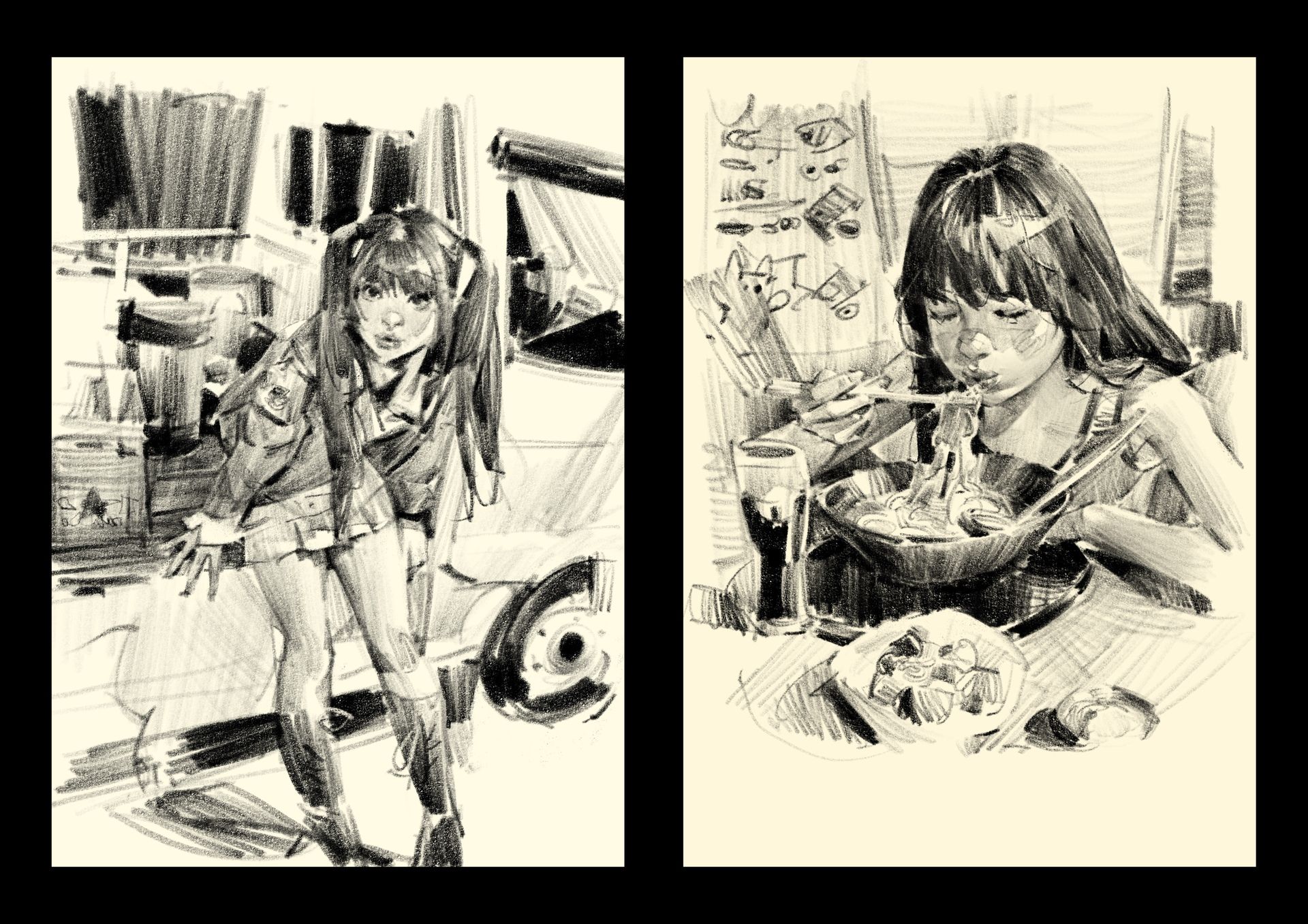
Another example: perspective is bent slightly to emphasize movement and design over accuracy.
We all have patterns like that —
some that come from repetition, others from intention.
The key is simply to know which is which.
💬 A Thought to Leave You With
Maybe take a moment to look at your own drawings.
Ask yourself:
“Which parts come from habit — and which come from choice?”
I try to ask myself that question often, too.
And every time I do, I find something new.
Not just about my drawings, but about how I see.
— Brooks
🧵 Daily Sketches on Threads
If you’d like to see more of my daily sketches,
I’m posting regularly on Threads.
You're always welcome to drop by. 🐾