- Drawings by Brooks Kim
- Posts
- What Can a Stroke Really Do?
What Can a Stroke Really Do?
A stroke is more than just an outline. It carries information.

brooks kim
May 29, 2025
Short, repeated strokes with pressure can describe areas where form turns away from light — under a chin, inside a mouth, or under a curled limb. These strokes suggest volume and weight where light barely reaches.
→ Example: shadow tucked under a jaw, a cat’s lifted paw, or a yawn’s inner edge.

Close-up of dense strokes showing compressed form and shadow
▶ Bright edge and open contrast
When a stroke thins out or leaves a deliberate gap,
it can describe bright edges where light directly hits — especially on flat planes.
This absence of line often makes the light feel sharper.
→ Example: edges of a box, forehead ridge, or any lit edge where the form turns sharply.

Box corner where light is shown by the absence of line
▶ Fine texture and surface detail
By adjusting speed and pressure, a stroke can create texture — hair, fur, or even the grain of skin or fabric. Controlled repetition and rhythm make the surface come alive.
→ Example: flowing hair, fur, whiskers, folds in cloth.

Strokes defining flow and grain of hair strands
▶ Hesitation and emotional tension
A trembling or broken stroke, or one that pulls back slightly, can create a sense of fragility or emotion. It often appears around expressive areas — the mouth, eyelids, hands. → Example: soft vibration around lips, hesitated mark near the eye
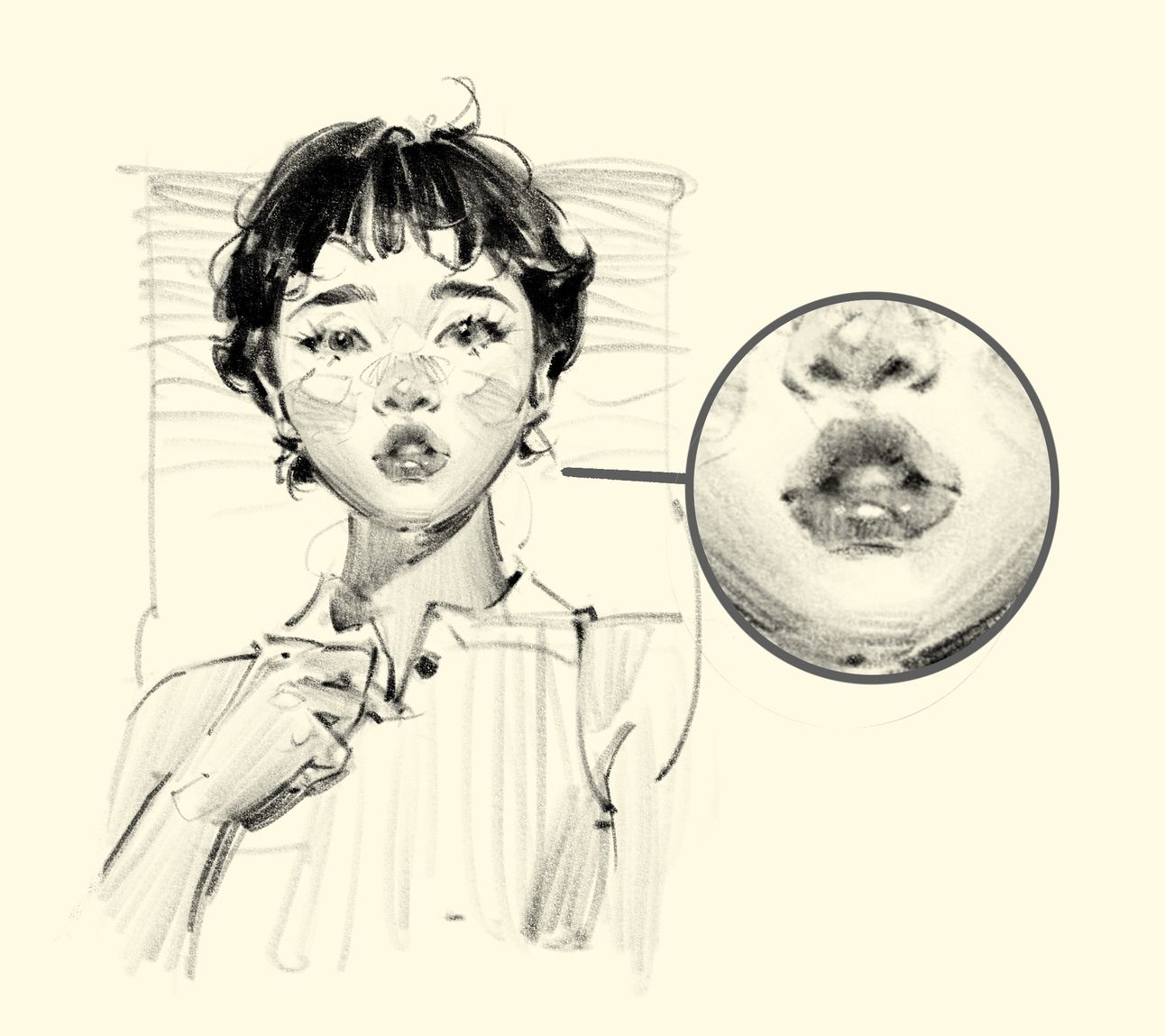
Loose marks around the mouth suggesting breath or pause
🧭 Conclusion:
We don’t just use strokes to separate shapes.
We use them to express shadow, light, texture, movement, even emotion.
In that sense, a stroke is a kind of visual language.
❓Final question:
Is your stroke simply describing form—
or is it communicating something more?