- Drawings by Brooks Kim
- Posts
- Why Does My Drawing Look Off?
Why Does My Drawing Look Off?
Understanding Negative Space for More Accurate Drawings

brooks kim
August 26, 2025
We focus on the figure—but we draw the space around it too.
When we draw, we naturally focus on the object itself—what we’re trying to capture.
But sometimes, that focus leads us to distort the actual form.
We try to draw “an arm,” “a face,” or “a cat,”
but in doing so, we forget to see how the object sits in its surrounding space.
That space—the negative space—can act as a powerful guide.
Drawing isn’t just about building a figure;
it’s also about carving out the shape that surrounds it.
🟦 Example A: Watch the shape beneath the elbow.
Don’t just draw the arm. Check the triangle below it.

In the example above, I raised my arm in front of a light background and took a photo.
In version A, I drew the arm’s silhouette directly.
In version B, I focused instead on the shapes around the arm—
the triangle between my elbow and body, and the space between my fingers.
What I noticed is this:
When I only thought “this is an arm,” the form got stiff or tilted.
But when I looked again and asked,
“Is this negative shape accurate?”
the entire structure of the figure became more honest.
🧢 Example B: The girl in the cap
From general forms to clean silhouette
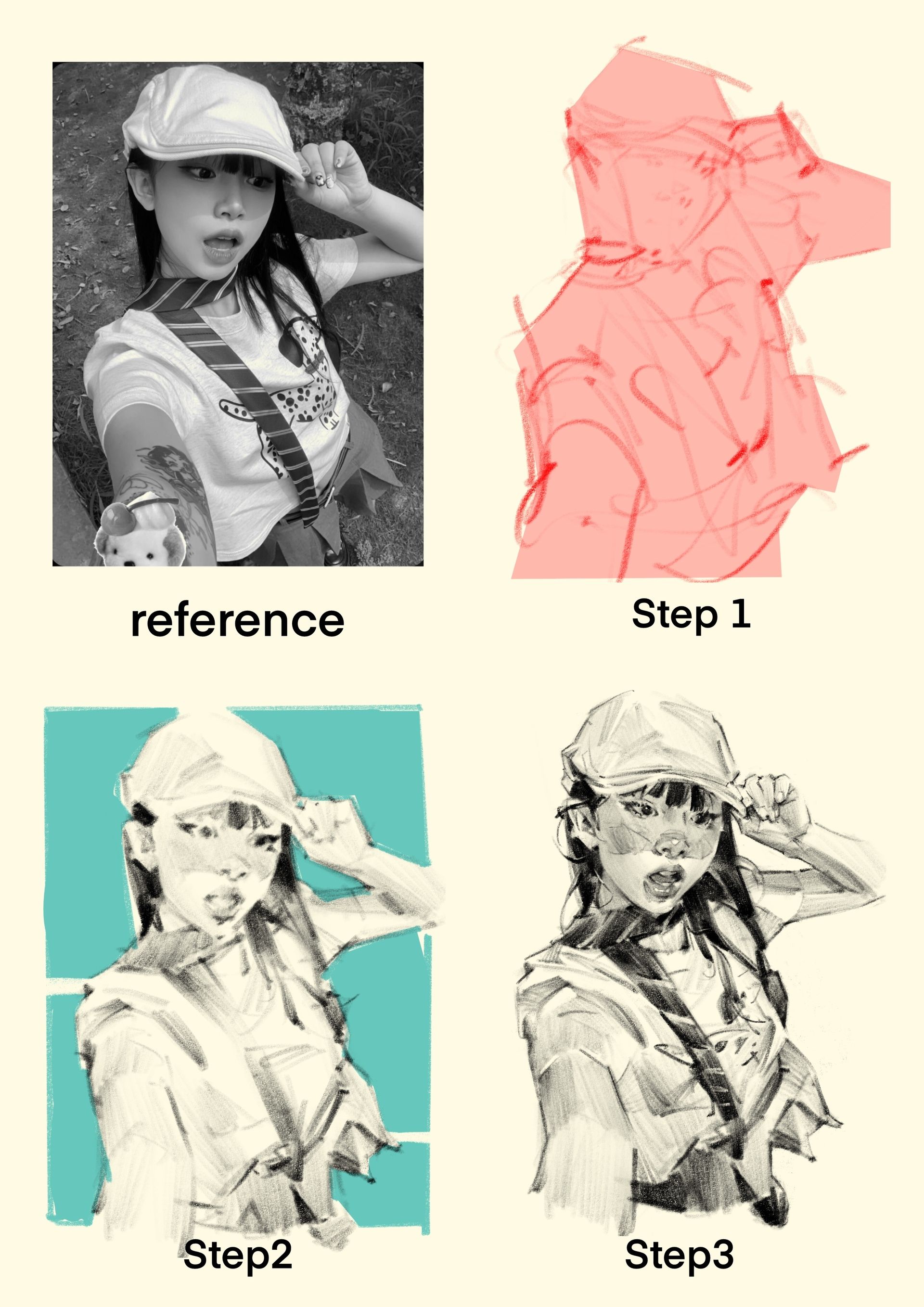
In Step 1, I start loosely with guide lines based on the overall figure.
At this point, it’s easy to make subtle mistakes—like a slanted neck or a stretched arm.
They feel “mostly okay,” but something’s off.
In Step 2, I slow down and begin identifying key negative spaces:
the triangular gaps between the arm and cap, the shapes under the jaw,
and the patches between strands of hair and shirt.
In Step 3, I refine the silhouette based on those spaces—
and not just by correcting the outline of the body.
This is where distortion gets cleaned up.
It’s not about drawing light and shadow.
It’s about using space around the form to anchor it objectively.
So why does this help?
In psychology, we call this the figure-ground relationship.
The human brain automatically separates what it thinks is the “subject” from the “background.”
But that separation can fool us when drawing—
especially if we’re focused only on what something is (“that’s a face”)
instead of how it sits in space.
By flipping your attention toward negative space,
you give yourself a mirror—something objective to compare against.
Try this in your next drawing:
Instead of just thinking: “How does the arm look?”
try also asking: “What shape is being carved out underneath it?”
These two ways of seeing—figure and space—balance each other.
They keep your drawings honest.
Final Note
This isn’t about drawing shadows.
This is about structure.
Let negative space guide your shape—and see how much cleaner your form becomes.
✎ Try it this week: Draw something by starting with negative shapes first—
or at least, checking them as often as you check your outlines.
— Brooks